

Crane Positioning Sensor: Driving Precision in Automated Crane Systems
Automation is transforming material handling across industries. Modern cranes are no longer operated solely by skilled personnel—they increasingly rely on intelligent control systems capable of positioning heavy loads with remarkable precision. Whether in ports, steel mills, warehouses, manufacturing facilities, or logistics centers, accurate positioning has become essential for improving productivity and reducing operational risks.
A crane positioning sensor plays a vital role in these automated systems. By providing continuous and accurate position feedback, laser-based sensors allow cranes to move efficiently, stop precisely, and complete repetitive lifting tasks with minimal human intervention.
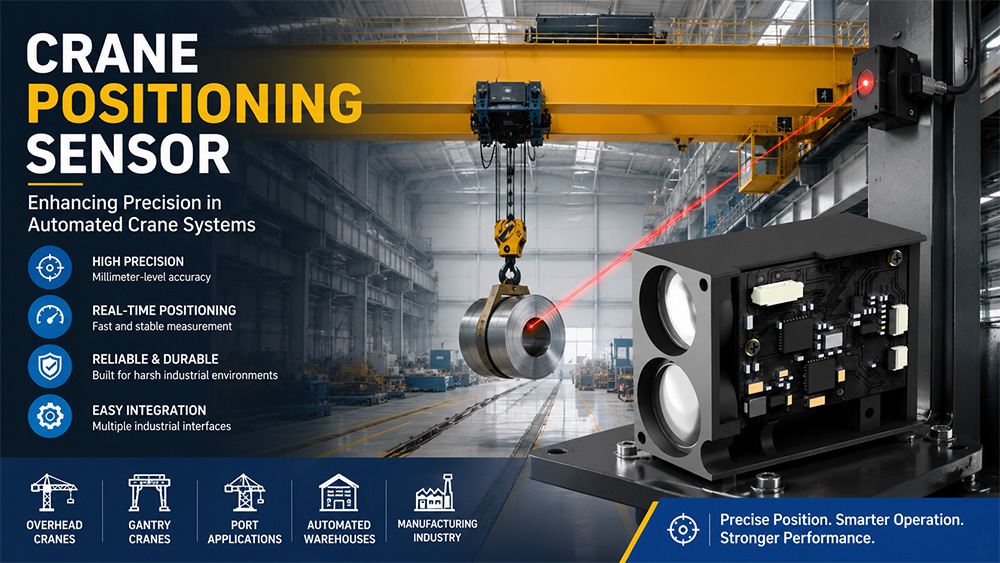
Compared with traditional positioning methods such as mechanical limit switches, cable encoders, or manual alignment, laser measurement technology delivers higher accuracy, longer measuring distances, and greater reliability in challenging industrial environments.
Why Accurate Crane Positioning Matters
Industrial cranes frequently transport valuable equipment, steel coils, shipping containers, production materials, and heavy machinery. In many facilities, cranes travel hundreds of meters every day while repeatedly stopping at designated loading or unloading points.
Small positioning errors may seem insignificant, but they can create several operational problems:
- Longer loading cycles
- Misaligned material placement
- Increased equipment wear
- Reduced production efficiency
- Additional operator corrections
- Greater maintenance costs
As factories continue adopting Industry 4.0 technologies, automated cranes require highly reliable positioning information that can be integrated directly into PLCs and intelligent control systems.
This is where a crane positioning sensor becomes an indispensable component.
Limitations of Traditional Positioning Methods
Many existing crane systems still depend on mechanical positioning devices, including travel switches, rotary encoders, or cable measuring systems.
Although these technologies have served industry for years, they present several disadvantages.
Mechanical Wear
Moving components gradually wear over time, reducing positioning accuracy and increasing maintenance requirements.
Limited Measurement Distance
Mechanical solutions often struggle with very long travel distances commonly found in ports and large industrial workshops.
Environmental Sensitivity
Dust, vibration, moisture, and temperature changes can reduce measurement reliability.
Installation Complexity
Mechanical measuring systems typically require additional pulleys, cables, or mounting structures that increase installation time and maintenance costs.
Laser measurement technology eliminates many of these limitations by providing non-contact distance measurement with minimal maintenance.
How a Crane Positioning Sensor Works
A laser positioning sensor for cranes emits a focused laser beam toward a fixed reference target or reflective surface.
After receiving the reflected signal, the sensor calculates the precise distance using advanced optical measurement technology. The measured value is continuously transmitted to the crane controller, allowing real-time position updates throughout the entire travel path.
Since the measurement is completely non-contact, there is no mechanical friction or physical wear.
Modern positioning sensors also provide fast update rates, allowing the control system to adjust crane movement instantly during acceleration, deceleration, and stopping.
Applications of Crane Positioning Sensors
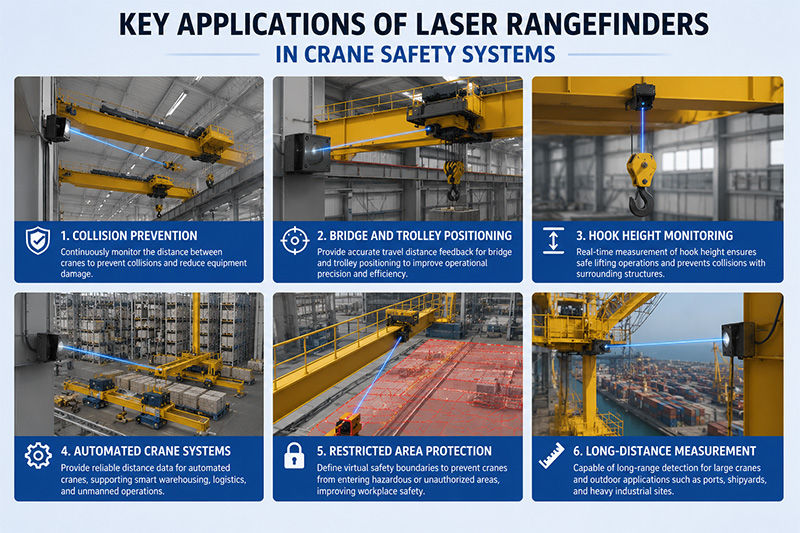
Overhead Crane Positioning
Manufacturing facilities frequently use overhead cranes for moving raw materials and finished products.
A crane positioning sensor ensures the bridge and trolley stop precisely at predefined locations, improving handling efficiency while reducing unnecessary corrections.
Automated Storage Warehouses
Automated storage and retrieval systems (AS/RS) require extremely accurate positioning.
Laser positioning enables cranes to align with storage racks quickly, improving inventory handling while minimizing placement errors.
Port Container Handling
Container terminals operate large gantry cranes that travel long distances while lifting containers weighing several tons.
An industrial crane positioning system provides accurate travel information, allowing operators and automation software to position containers efficiently despite challenging outdoor conditions.
Steel Manufacturing
Steel mills often operate cranes in environments containing dust, heat, and vibration.
Laser positioning sensors maintain stable measurement performance under these demanding conditions, supporting continuous production.
Intelligent Logistics Centers
Modern logistics facilities increasingly rely on automated cranes to transport pallets and large materials.
Continuous positioning feedback helps optimize routing, shorten transportation cycles, and improve warehouse throughput.
Advantages of Laser Positioning Technology
Higher Positioning Accuracy
Laser measurement provides highly accurate distance data throughout the entire travel path.
Precise positioning reduces placement errors and improves repeatability during automated operations.
Faster Operating Cycles
Continuous position feedback enables cranes to reach target locations more efficiently.
Less manual adjustment means shorter production cycles and higher productivity.
Reduced Maintenance
Because the measurement is contactless, there are fewer moving components subject to mechanical wear.
Maintenance intervals become longer, reducing operating costs.
Excellent Long-Distance Performance
Unlike many traditional positioning technologies, laser sensors maintain high accuracy over long measuring distances.
This makes them suitable for container terminals, steel plants, warehouses, and large manufacturing facilities.
Easy System Integration
Modern automated crane positioning technology supports multiple industrial interfaces, including:
- RS232
- RS485
- UART
- Ethernet
- CAN Bus
- Modbus
These communication options simplify integration with PLCs, industrial computers, and automation software.
Selecting the Right Crane Positioning Sensor
Choosing the correct positioning sensor depends on several application requirements.
Measuring Distance
Ensure the sensor covers the crane's complete travel distance while maintaining stable accuracy.
Measurement Accuracy
Applications involving automated storage or precision manufacturing typically require millimeter-level positioning performance.
Measurement Speed
Fast-moving cranes benefit from sensors capable of providing high-frequency measurement updates for smooth motion control.
Environmental Protection
Industrial environments may expose sensors to:
- Dust
- Fog
- Rain
- Oil mist
- Strong vibration
- Temperature variations
Selecting sensors designed for industrial applications improves long-term reliability.
Communication Compatibility
Verify that the positioning sensor supports the communication protocol required by the existing control system.
Future Development of Crane Positioning Systems
As industrial automation continues to evolve, crane positioning systems are becoming increasingly intelligent.
Future developments are expected to include:
- AI-assisted motion optimization
- Digital twin integration
- Predictive maintenance
- Cloud-based equipment monitoring
- Autonomous material handling
- Multi-crane coordination
- Smart factory connectivity
Laser positioning technology will continue serving as the foundation for these intelligent crane systems by delivering accurate and reliable positioning data.
Conclusion
Automation demands positioning systems that are accurate, reliable, and capable of operating in demanding industrial environments.
A crane positioning sensor provides continuous, high-precision measurement that improves material handling efficiency, enhances positioning accuracy, and supports intelligent crane control. Compared with traditional mechanical positioning methods, laser measurement offers greater reliability, reduced maintenance, and better integration with modern automation platforms.
Whether deployed in warehouses, ports, manufacturing plants, or logistics centers, laser positioning sensors for cranes are becoming an essential technology for improving operational performance and enabling the next generation of automated crane systems.