

Laser Sensor Measuring Range Selection Guide for Industrial Applications
Introduction
Selecting the correct measuring range is one of the most overlooked steps when choosing a laser distance sensor. Manybuyers focus on specifications such as accuracy, measurement frequency, communication interfaces, or protection ratings, but the measuring range often has the greatest impact on system performance.
In industrial projects, selecting a sensor with an unsuitable range can lead to unstable readings, unnecessary costs, or integration challenges. Whether the application involves robotic positioning, warehouse automation, AGV navigation, structural monitoring, or outdoor surveying, understanding the required laser sensor measuring range is critical.
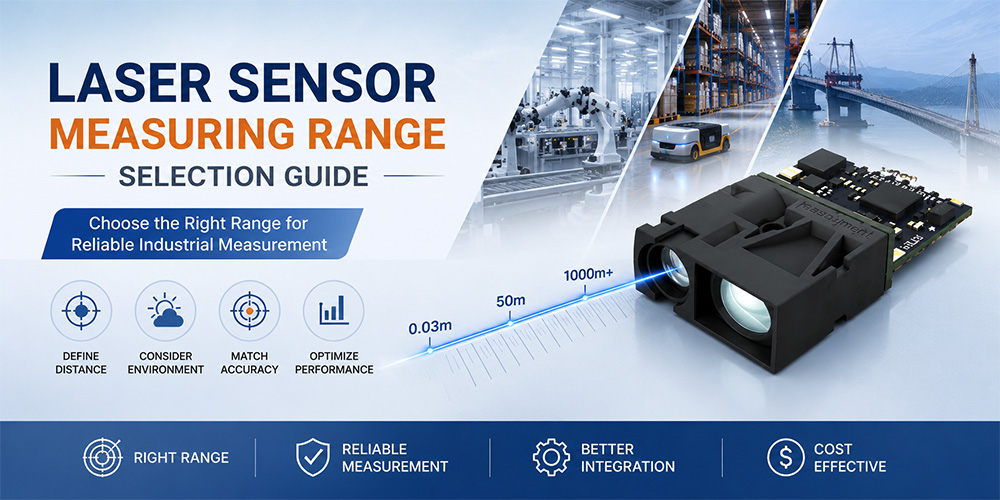
This guide explains how experienced engineers evaluate measuring range requirements and select the most suitable sensor for industrial applications.
Why Measuring Range Should Be Considered First
The measuring range determines whether a sensor can reliably detect a target under actual operating conditions.
A common mistake is assuming that a longer range automatically provides better performance. In practice, every project has an optimal measurement window.
For example:
- A robotic arm may only require measurements within 5 meters.
- A warehouse shuttle system may require 20–50 meters.
- A bridge monitoring project may require hundreds of meters.
- A UAV mapping platform may require several kilometers.
The ideal sensor is the one that comfortably covers the required distance while maintaining stable performance.
Step 1: Determine the Maximum Measurement Distance
The first question engineers should ask is:
"What is the furthest distance the sensor must measure during normal operation?"
Rather than selecting a sensor that exactly matches the maximum distance, a safety margin should be included.
Typical recommendation:
| Actual Requirement | Recommended Sensor Range |
|---|---|
| 10m | 20m–30m |
| 30m | 50m–80m |
| 100m | 150m–200m |
| 1000m | 1500m–2000m |
This additional margin helps compensate for environmental influences and target reflectivity variations.
Step 2: Evaluate Target Characteristics
Not all targets reflect laser energy equally.
Reflectivity significantly influences achievable measuring distance.
High Reflectivity Targets
Examples include:
- White painted surfaces
- Reflective signs
- Metal panels
These materials generally allow sensors to achieve their rated measuring range.
Low Reflectivity Targets
Examples include:
- Black rubber
- Asphalt
- Dark composite materials
These surfaces absorb more laser energy and may reduce effective measurement distance considerably.
When evaluating a laser distance sensor selection guide, target characteristics should always be considered alongside nominal specifications.
Step 3: Consider Indoor and Outdoor Conditions
Environmental conditions often have a greater impact on performance than distance itself.
Indoor Applications
Typical examples:
- Manufacturing equipment
- Robotics
- Conveyor systems
- Automated warehouses
Indoor environments generally provide:
- Stable lighting
- Minimal weather influence
- Consistent target conditions
As a result, shorter-range sensors often perform exceptionally well.
Outdoor Applications
Outdoor installations introduce additional challenges:
- Direct sunlight
- Rain
- Snow
- Dust
- Fog
For outdoor projects, engineers should choose sensors specifically designed for harsh environmental conditions.
Step 4: Balance Accuracy and Measuring Distance
There is often a trade-off between extreme distance capability and ultra-high accuracy.
For example:
Precision Positioning Systems
Applications include:
- Semiconductor equipment
- Robotic assembly
- Industrial automation
These systems prioritize:
- Millimeter-level accuracy
- Fast response
- High repeatability
Long-Distance Monitoring Systems
Applications include:
- Mining
- Infrastructure inspection
- Surveying
These projects prioritize:
- Long-distance capability
- Environmental robustness
- Reliable target acquisition
The correct choice depends on the application's primary objective.
Step 5: Analyze Measurement Frequency Requirements
Distance alone does not determine performance.
Many automation systems require frequent measurement updates.
Examples include:
High-Speed Automation
- AGV navigation
- Robotic movement
- Conveyor tracking
These applications may require:
- 30Hz
- 50Hz
- 100Hz
or higher update rates.
Static Monitoring
Examples:
- Structural monitoring
- Reservoir level measurement
- Bridge deformation monitoring
These applications often require lower update frequencies but longer measurement distances.
Common Measuring Range Selection Mistakes
Choosing Excessive Range
Many buyers assume a longer range is always better.
This often results in:
- Higher procurement costs
- Larger sensor size
- Increased integration complexity
Ignoring Environmental Conditions
Laboratory specifications rarely reflect real-world environments.
Always evaluate:
- Lighting conditions
- Dust levels
- Weather exposure
- Target materials
Focusing Only on Accuracy
Accuracy is important, but it should be evaluated together with measuring distance, speed, and operating conditions.
Typical Measuring Range Recommendations by Industry
| Industry | Recommended Range |
|---|---|
| Robotics | 0.03m–20m |
| AGV Systems | 0.1m–50m |
| Warehouse Automation | 1m–80m |
| Industrial Automation | 0.03m–80m |
| Construction Monitoring | 100m–1000m |
| Mining | 500m–4000m |
| UAV Surveying | 100m–3000m |
These values provide a useful starting point during the sensor selection process.
Conclusion
Choosing the correct laser sensor measuring range requires more than simply selecting the longest available measurement distance. Engineers must evaluate target characteristics, environmental conditions, accuracy requirements, update frequency, and installation constraints.
By following a structured selection process, industrial users can reduce project costs, improve measurement reliability, and achieve better overall system performance.
The most effective solution is not necessarily the sensor with the greatest range—it is the sensor whose measuring range is properly matched to the application.