

How to Choose a Laser Distance Sensor for Industrial Projects
Selecting the right laser distance sensor can significantly impact the performance, reliability, and efficiency of an industrial system. Whether you are designing automated machinery, warehouse automation equipment, robotic systems, smart infrastructure, or manufacturing inspection solutions, choosing an appropriate sensor ensures accurate measurements and long-term operational stability.
However, many engineers and procurement teams focus only on measurement range and price while overlooking other critical specifications that directly affect real-world performance.
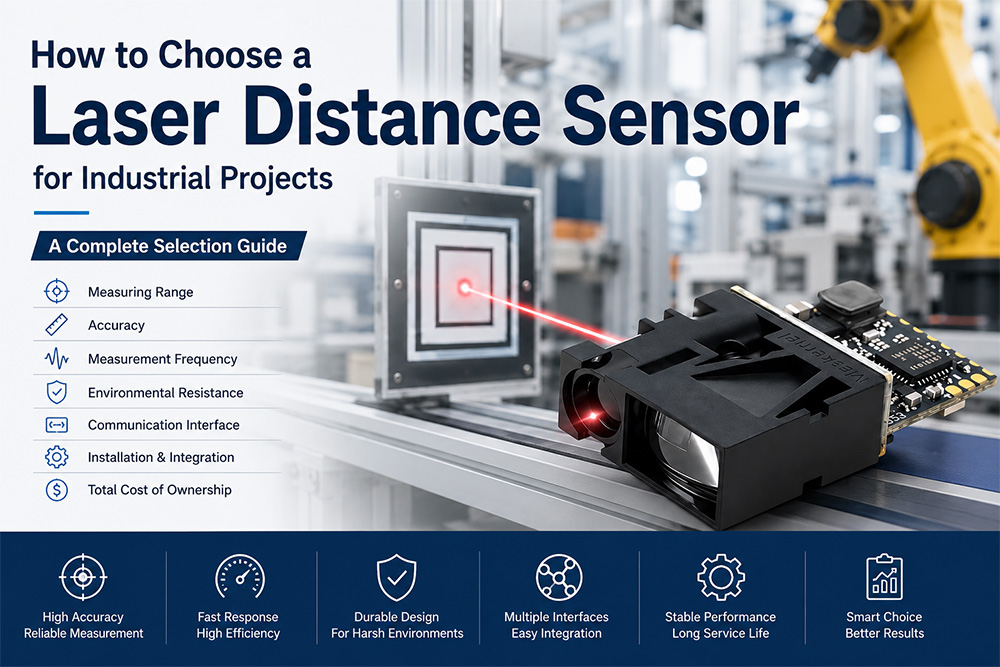
This guide explains the most important factors to consider when choosing a laser distance sensor for industrial projects and helps you avoid common selection mistakes.
Why Sensor Selection Matters
Laser distance sensors are widely used across industrial sectors because they provide fast, accurate, and non-contact measurement capabilities.
Common applications include:
- Factory automation
- AGV and AMR navigation
- Robotic positioning
- Material handling systems
- Warehouse automation
- Structural monitoring
- Crane positioning
- Industrial safety systems
- Machine alignment
- Dimensional inspection
Choosing the wrong sensor can lead to:
- Inaccurate measurements
- System downtime
- Reduced production efficiency
- Increased maintenance costs
- Frequent sensor replacement
Proper selection at the design stage helps prevent these issues and improves overall project reliability.
1. Define the Required Measuring Range
The first specification to evaluate is measuring distance.
Different industrial applications require different ranges:
| Application | Typical Distance |
|---|---|
| Conveyor positioning | 0.1–5m |
| Robotic arm guidance | 0.1–10m |
| Warehouse automation | 1–30m |
| AGV navigation | 1–50m |
| Bridge monitoring | 5–100m |
| Crane positioning | 10–300m+ |
Many engineers select sensors with excessively long ranges, which often increases cost unnecessarily.
A practical approach is to choose a sensor with a measuring range approximately 20–30% greater than the maximum expected operating distance.
This provides a safety margin while maintaining optimal performance.
2. Determine the Accuracy Requirement
Accuracy requirements vary dramatically across industries.
For example:
Millimeter-Level Accuracy
Suitable for:
- Precision manufacturing
- CNC equipment
- Electronic assembly
- Robotic positioning
- Quality inspection
Typical requirement:
±1 mm to ±5 mm
Centimeter-Level Accuracy
Suitable for:
- Vehicle detection
- Warehouse positioning
- Industrial monitoring
Typical requirement:
±10 mm to ±50 mm
Meter-Level Accuracy
Suitable for:
- Long-range outdoor monitoring
- Security applications
- Surveying support systems
The highest accuracy is not always necessary. Select a sensor that matches actual project requirements to optimize cost and performance.
3. Consider Measurement Frequency
Measurement frequency determines how often the sensor updates distance data.
This specification is critical in dynamic applications.
Low-Speed Applications
Examples:
- Tank level monitoring
- Structural monitoring
- Storage management
Typical requirement:
1–10 Hz
Medium-Speed Applications
Examples:
- Conveyor systems
- Warehouse automation
- Position verification
Typical requirement:
10–50 Hz
High-Speed Applications
Examples:
- Robotics
- Motion control
- Industrial automation
- Vibration monitoring
Typical requirement:
50–100 Hz or higher
Insufficient measurement frequency can cause delayed responses and reduced system accuracy.
4. Evaluate Target Surface Characteristics
Sensor performance depends heavily on the target being measured.
Factors include:
Surface Color
Dark objects generally reflect less laser energy than light-colored surfaces.
Surface Material
Performance may vary when measuring:
- Metal
- Plastic
- Rubber
- Glass
- Concrete
- Painted surfaces
Surface Finish
Highly reflective or glossy surfaces can affect measurement quality.
Whenever possible, test the sensor under actual operating conditions before final deployment.
5. Assess Environmental Conditions
Industrial environments are often challenging.
Important considerations include:
Dust
Manufacturing plants, mines, and construction sites may contain airborne particles that affect laser transmission.
Moisture
Outdoor systems often experience rain, condensation, and humidity.
Temperature
Industrial equipment may operate in environments ranging from sub-zero temperatures to high-heat production areas.
Vibration
Heavy machinery can create continuous vibration that affects measurement stability.
Choosing an industrial-grade sensor with suitable environmental protection helps maintain long-term reliability.
6. Check the Protection Rating
The IP rating indicates resistance to dust and water.
Common ratings include:
| Rating | Protection Level |
| IP54 | Dust protected and splash resistant |
| IP65 | Dust tight and water resistant |
| IP67 | Temporary immersion protection |
| IP68 | Continuous immersion protection |
Indoor automation systems may only require IP54 protection, while outdoor infrastructure projects often require IP67 or higher.
7. Select the Right Communication Interface
Modern industrial systems require seamless integration.
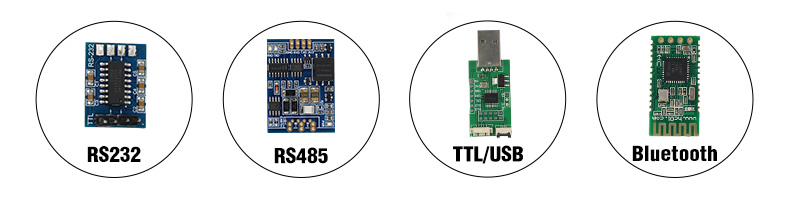
Common interfaces include:
UART
Ideal for embedded systems and microcontrollers.
RS232
Widely used in industrial equipment and legacy systems.
RS485
Excellent for long-distance communication and industrial environments.
Modbus
Popular in PLC and industrial automation applications.
Ethernet
Suitable for networked monitoring systems.
CAN Bus
Frequently used in automotive and mobile machinery applications.
Always verify compatibility with your control system before selecting a sensor.
8. Consider Installation Space
Space constraints often influence sensor selection.
Compact sensors are preferred in:
- Drones
- Robotics
- Portable devices
- Smart instruments
- Embedded equipment
Larger sensors may offer longer ranges but require more installation space.
Consider:
- Sensor dimensions
- Mounting method
- Weight
- Cable routing requirements
during the design phase.
9. Indoor vs Outdoor Applications
Indoor environments typically provide stable lighting conditions and predictable operating temperatures.
Outdoor applications introduce additional challenges:
- Direct sunlight
- Fog
- Rain
- Snow
- Dust
- Temperature fluctuations
Sensors designed for outdoor use often include enhanced optical filtering and environmental protection features.
10. Evaluate Total Cost of Ownership
The lowest-priced sensor is not always the most economical choice.
Consider:
- Initial purchase cost
- Installation cost
- Maintenance requirements
- Calibration frequency
- Expected lifespan
- Downtime risk
A higher-quality sensor often delivers lower long-term operating costs through improved reliability and reduced maintenance.
Common Mistakes When Choosing a Laser Distance Sensor
Many industrial projects encounter problems because of avoidable selection errors.
Common mistakes include:
- Choosing range based solely on specifications rather than real conditions
- Ignoring environmental factors
- Overlooking communication compatibility
- Purchasing based only on price
- Selecting unnecessarily high accuracy
- Neglecting mounting requirements
- Failing to test on actual target materials
Avoiding these mistakes can significantly improve project outcomes.
Future Trends in Industrial Laser Measurement
As Industry 4.0 continues to evolve, laser distance sensors are becoming increasingly important for:
- Smart factories
- Predictive maintenance
- Autonomous mobile robots
- Digital twins
- AI-powered automation
- Remote monitoring systems

Future sensors will offer higher accuracy, faster measurement rates, smaller form factors, and improved connectivity for industrial IoT platforms.
Conclusion
Choosing the right laser distance sensor requires more than comparing measurement range and price. Engineers should carefully evaluate accuracy, frequency, environmental conditions, communication interfaces, installation requirements, and long-term reliability.
By understanding these factors early in the design process, industrial teams can select a sensor that delivers accurate performance, seamless integration, and dependable operation throughout the entire project lifecycle.
A well-chosen laser distance sensor not only improves measurement quality but also enhances productivity, reduces maintenance costs, and supports the long-term success of industrial automation systems.