

How to Choose an I2C Laser Distance Sensor for Embedded Systems
As embedded electronics continue to become smaller and smarter, choosing the right distance measurement technology is more important than ever. Whether you're designing a robot, an AGV, a handheld device, or an industrial controller, selecting the right I2C laser distance sensor can improve system performance while reducing development complexity.
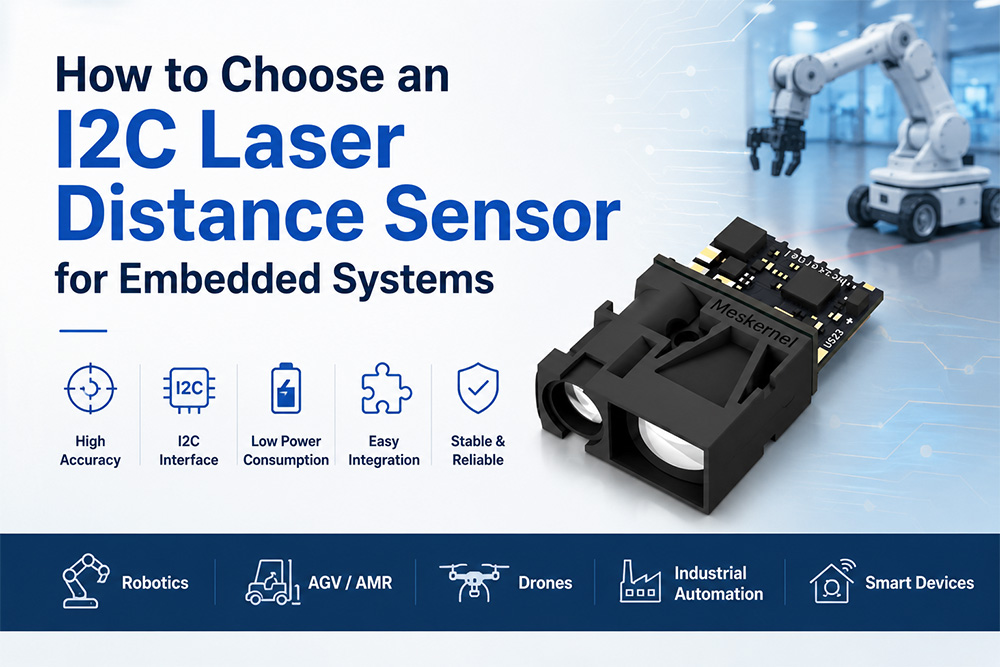
Unlike analog sensors, an I2C laser distance sensor delivers digital data through a simple two-wire interface, making integration faster and PCB layouts cleaner. However, not every sensor is suitable for every project. Understanding the most important selection criteria helps engineers avoid unnecessary redesigns and achieve reliable long-term performance.
Start with Your Application
The first step is defining what your project actually needs.
Ask yourself a few basic questions:
- What is the maximum measuring distance?
- How accurate should the measurements be?
- Will the sensor work indoors or outdoors?
- Is continuous measurement required?
- Is the system powered by batteries?
Your answers will quickly narrow down the best laser distance sensor I2C for the application.
For example, warehouse robots may require long-range measurement, while consumer electronics usually prioritize compact size and low power consumption.
Evaluate Measurement Performance
Measurement specifications should always match real operating conditions rather than simply selecting the highest numbers available.
When comparing an embedded laser sensor, focus on:
- Measuring range
- Accuracy
- Repeatability
- Measurement frequency
- Target reflectivity
For positioning, alignment, and automation tasks, stable repeatability is often more valuable than maximum measuring distance.
Consider Interface Compatibility
One of the biggest advantages of an I2C laser distance sensor is easy integration with mainstream embedded platforms.
Most modern controllers support I2C communication, including:
- STM32
- ESP32
- Arduino
- Raspberry Pi
- NXP
- Nordic MCUs
Before selecting a sensor, verify operating voltage, communication protocol, and available software libraries. Good documentation can significantly shorten development time.
Pay Attention to Size and Power
Embedded products often have limited installation space.
A compact laser ranging module is easier to integrate into portable devices, robots, drones, and smart equipment. At the same time, low operating current and standby power help extend battery life in mobile applications.
Balancing performance with size and energy efficiency usually produces the best overall design.
Think Beyond the Datasheet
Specifications are important, but long-term reliability matters just as much.
When evaluating an embedded laser sensor, also consider:
- Operating temperature
- Ambient light resistance
- Dust and vibration tolerance
- Product consistency
- Technical support
These factors often determine how well the sensor performs after deployment.
Typical Embedded Applications
An I2C laser distance sensor is widely used across many industries.
Typical applications include:
- Mobile robots
- AGVs and AMRs
- Industrial automation
- Smart home devices
- UAVs and drones
- Medical equipment
- Warehouse logistics
- Agricultural automation
Its simple wiring and digital communication make it particularly suitable for compact embedded systems with multiple peripherals.
A Simple Selection Checklist
Before making your final decision, confirm that the sensor meets these requirements:
✔ Measuring range fits your project
✔ Accuracy meets system requirements
✔ I2C communication is supported
✔ Power consumption matches the power budget
✔ Module size fits the available space
✔ Documentation and technical support are available
A short checklist like this can help avoid compatibility issues later in the development process.
Conclusion
Selecting the right I2C laser distance sensor is about balancing measurement performance, interface compatibility, size, and reliability. Rather than focusing on a single specification, engineers should evaluate the complete system design and choose a solution that supports future expansion as well as current requirements.
A well-designed laser ranging module not only delivers accurate distance data but also simplifies integration, shortens development cycles, and improves the reliability of embedded products.
FAQ
What is an I2C laser distance sensor?
An I2C laser distance sensor measures distance and communicates digitally through the I2C interface using SDA and SCL lines.
Why choose an embedded laser sensor with I2C?
I2C simplifies wiring, reduces PCB complexity, and allows multiple devices to share the same communication bus.
Which controllers support laser distance sensor I2C?
Most STM32, ESP32, Arduino, Raspberry Pi, and many other microcontrollers support I2C communication.
What should I consider before choosing a laser ranging module?
Compare measuring range, accuracy, update rate, operating voltage, power consumption, and software support.
Is an I2C laser distance sensor suitable for industrial applications?
Yes. Many I2C laser distance sensor solutions are used in robotics, automation, logistics, and smart manufacturing because of their reliable digital communication and compact design.