

Why Compact Laser Rangefinder Sensors Are Important for UAV Systems
Unmanned aerial vehicles (UAVs) are becoming increasingly important across industries such as surveying, security, agriculture, logistics, and infrastructure inspection. As drone technology continues to evolve, the demand for lightweight and highly accurate sensing systems is also growing rapidly. Among these technologies, Compact Laser Rangefinder Sensors have become essential components for improving UAV performance and operational safety.
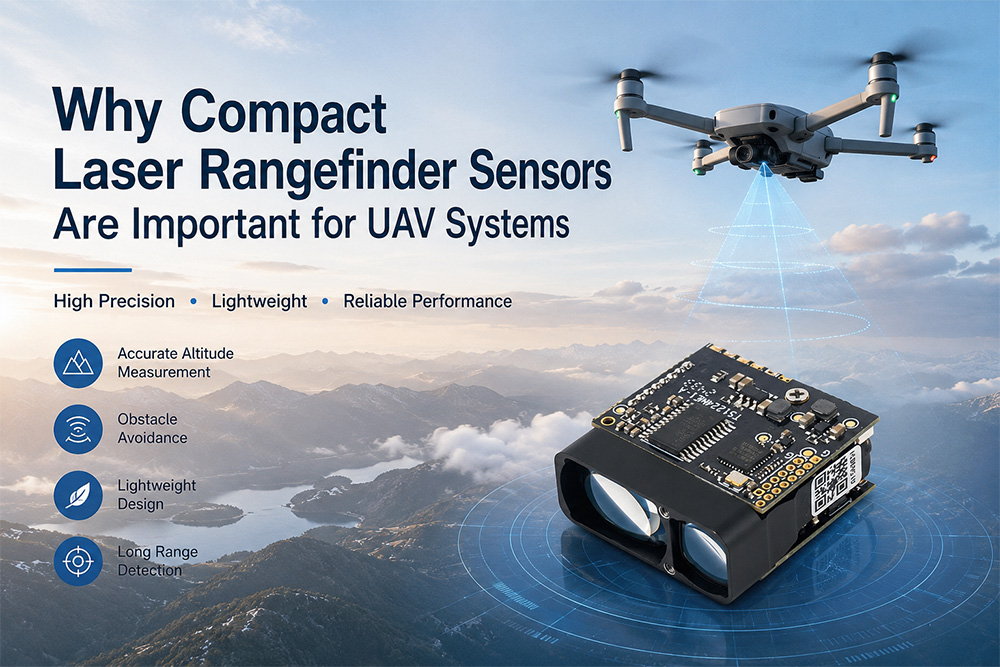
Compared with traditional measurement technologies, compact laser sensors offer higher precision, faster response speed, and better environmental adaptability. Their small size and lightweight structure make them especially suitable for modern UAV integration where payload capacity and energy efficiency are critical factors.
This article explains why compact laser rangefinder technology is important for UAV systems and how it supports advanced drone applications.
What Are Compact Laser Rangefinder Sensors?
Compact Laser Rangefinder Sensors are small laser-based distance measurement devices designed to calculate the distance between the sensor and a target object. These sensors commonly use phase shift or time-of-flight (TOF) technology to achieve precise measurements in real time.
Unlike bulky traditional rangefinding equipment, modern compact laser modules are optimized for embedded integration. They are designed with low power consumption, lightweight housing, and multiple communication interfaces such as UART, RS232, RS485, USB, and TTL.
For UAV manufacturers, reducing payload weight while maintaining high accuracy is extremely important. This is why lightweight laser distance sensors are widely used in drone platforms today.
Why UAV Systems Need Compact Laser Rangefinder Sensors
1. Improved Altitude Measurement Accuracy
One of the most important functions of a UAV is maintaining stable altitude during flight. GPS signals alone may not provide enough precision, especially in indoor environments or areas with signal interference.
A laser rangefinder sensor for UAV applications can deliver accurate real-time altitude measurements by continuously detecting the distance between the drone and the ground. This improves flight stability and enables smoother hovering performance.
Compact laser sensors can also help drones perform low-altitude operations more safely in complex environments.
2. Better Obstacle Avoidance Performance
Obstacle avoidance is critical for autonomous drone navigation. UAVs operating in forests, industrial sites, warehouses, or urban environments must detect obstacles quickly and accurately.
Compact laser rangefinder modules provide high-speed distance feedback, allowing UAV systems to identify nearby objects and adjust flight paths instantly. Compared with ultrasonic sensors, laser-based detection typically offers:
- Longer measurement distance
- Faster response speed
- Higher measurement precision
- Better directional accuracy
- Improved resistance to environmental noise
These advantages make compact laser sensors ideal for intelligent drone navigation systems.
3. Reduced Payload Weight
Weight is one of the most important considerations in UAV design. Heavy payloads reduce flight time, increase energy consumption, and limit maneuverability.
Modern Compact Laser Rangefinder Sensors are designed with ultra-small dimensions and lightweight structures. Some modules weigh only a few grams while still providing long-range measurement capability.
This allows UAV manufacturers to integrate advanced ranging technology without significantly affecting flight endurance or overall drone efficiency.
Applications of Compact Laser Rangefinder Sensors in UAV Systems
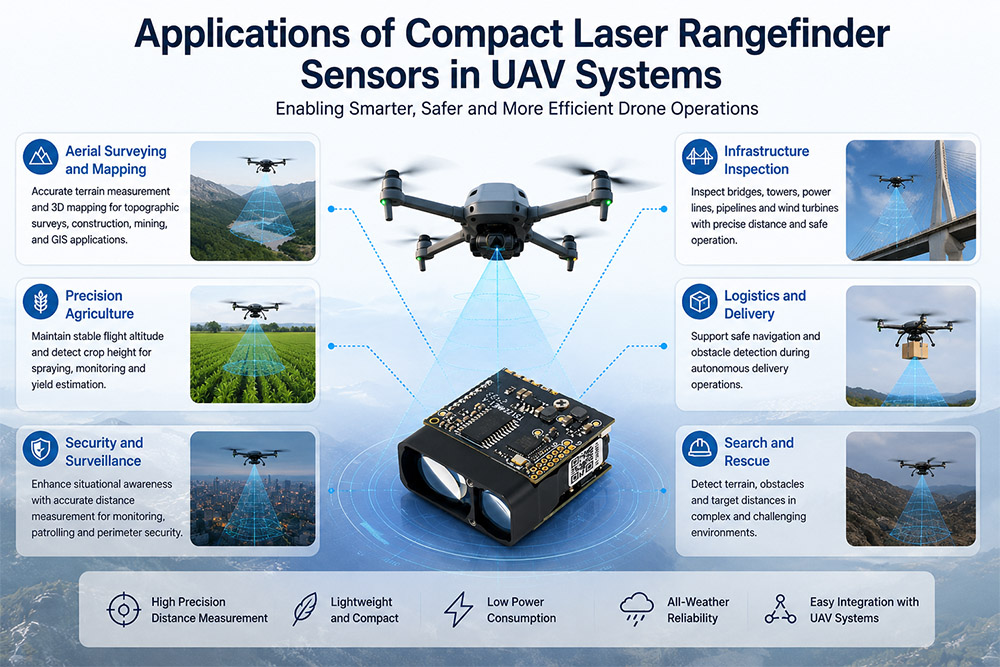
Aerial Surveying and Mapping
Drone mapping systems require accurate distance measurement to generate high-quality terrain models and 3D maps. Compact laser sensors help improve positioning accuracy and terrain-following capability during flight.
They are commonly used in:
- Topographic surveying
- Construction site mapping
- Mining inspection
- Geographic information systems (GIS)
Precision Agriculture
Agricultural drones rely on accurate height control and obstacle detection when monitoring crops or spraying pesticides.
A lightweight laser distance sensor enables UAVs to maintain stable flight altitude over uneven farmland, improving spraying accuracy and operational safety.
As smart agriculture continues to expand globally, laser sensing technology is becoming increasingly important in modern farming equipment.
Infrastructure Inspection
Many UAVs are used for inspecting bridges, power lines, pipelines, wind turbines, and communication towers.
Compact laser rangefinder modules help drones maintain safe inspection distances while collecting high-resolution images and data. Accurate ranging also improves autonomous positioning during close-range inspection tasks.
Security and Surveillance
Security drones often operate at night or in complex outdoor environments. A drone laser rangefinder module can support accurate target distance measurement and improve situational awareness during surveillance missions.
Combined with thermal imaging or night vision systems, compact laser sensors provide more reliable environmental perception capabilities.
Key Features to Consider When Choosing a UAV Laser Rangefinder Sensor
Selecting the right sensor depends on the specific UAV application. Important factors include:
Measurement Range
Different drone applications require different ranging distances. Industrial UAVs may need long-distance measurement capability, while indoor drones prioritize short-range precision.
Accuracy
High precision is essential for mapping, positioning, and autonomous navigation tasks.
Weight and Size
Compact dimensions and low weight help maximize UAV flight performance.
Interface Compatibility
Common interfaces such as UART, TTL, RS232, and RS485 simplify integration with flight controllers and embedded systems.
Power Consumption
Low power consumption is important for extending drone battery life.
Environmental Adaptability
Outdoor UAV systems often operate under challenging lighting and weather conditions, so stable sensor performance is critical.
The Future of Compact Laser Rangefinder Sensors in UAV Technology
As UAV systems become more intelligent and autonomous, the role of laser sensing technology will continue to expand. Future drones will require even faster response speed, higher measurement accuracy, and smaller integrated sensor solutions.
Emerging applications such as autonomous delivery drones, smart city monitoring, and AI-powered aerial inspection will further increase demand for compact and lightweight laser rangefinder technology.
Manufacturers are also focusing on improving sensor integration with AI navigation systems, edge computing platforms, and multi-sensor fusion technologies.
Conclusion
Compact laser rangefinder technology has become a key component in modern UAV systems. From altitude control and obstacle avoidance to mapping and infrastructure inspection, Compact Laser Rangefinder Sensors provide the precision and reliability required for advanced drone applications.
Their lightweight design, fast response speed, and high measurement accuracy make them an ideal solution for next-generation UAV platforms. As drone technology continues to evolve, compact laser sensing systems will play an even more important role in enabling safer, smarter, and more efficient aerial operations.