

How Industrial Sensors Automation Is Transforming Smart Manufacturing in 2026
Industrial sensors automation is rapidly becoming the foundation of modern smart manufacturing systems. As factories continue to adopt intelligent production technologies in 2026, the demand for accurate, fast, and reliable industrial sensing solutions is growing across nearly every industry.
From automated production lines and warehouse robotics to AGV navigation and machine positioning, advanced sensing technology is helping manufacturers improve efficiency, reduce labor costs, and optimize production accuracy. Among the most important technologies driving this transformation are laser measurement sensors, industrial laser rangefinders, and compact laser distance modules.
With the continued development of Industry 4.0 and AI-powered manufacturing, industrial automation systems now require real-time sensing data to support intelligent decision-making and automated control. High precision industrial sensors are becoming essential components in the next generation of smart factories.

Why Industrial Sensors Automation Matters
Traditional manufacturing systems relied heavily on manual operation and mechanical control methods. However, modern factories demand higher speed, better consistency, and greater production flexibility.
Industrial sensors automation enables machines to:
- Detect object position
- Measure movement distance
- Monitor production processes
- Improve robotic accuracy
- Reduce human error
- Enable intelligent machine control
By integrating advanced industrial sensors into automation systems, manufacturers can achieve higher productivity while reducing downtime and maintenance costs.
Laser sensing technology is especially important because it provides non-contact, high precision distance measurement with excellent repeatability and fast response speed.
The Rise of Laser Measurement Sensors
A laser measurement sensor uses laser technology to measure the distance between the sensor and a target object. Compared with ultrasonic or infrared sensors, laser-based systems typically offer:
- Higher accuracy
- Faster measurement speed
- Longer measuring distance
- Better anti-interference performance
- More stable industrial operation
These advantages make laser sensors highly suitable for factory automation applications.
In modern production environments, laser measurement sensors are widely used for:
Robotic Positioning
Industrial robots require accurate position feedback to improve assembly precision and automated movement control.
Conveyor Monitoring
Factories use laser sensors to detect materials moving along production lines and optimize workflow efficiency.
Automated Inspection
Laser sensing systems help manufacturers perform non-contact quality inspection and dimensional measurement.
Collision Avoidance
AGV robots and automated equipment rely on distance sensors to detect obstacles and navigate safely.
Industrial Laser Rangefinders for Smart Factories
The role of industrial laser rangefinder technology has expanded significantly in recent years. Originally used mainly for surveying and outdoor measurement, industrial laser rangefinders are now widely integrated into smart manufacturing equipment.
In automated factories, industrial laser rangefinders provide accurate distance measurement for:
- Robotic automation
- Smart warehousing
- Machine positioning
- Automated logistics
- Production line control
- Intelligent transportation systems
As manufacturing environments become more complex, the need for stable long-distance sensing solutions continues to increase.
Industrial laser rangefinders provide several important benefits:
Real-Time Distance Feedback
Continuous measurement allows machines to respond quickly and improve operational efficiency.
High Precision Performance
Advanced phase-shift laser technology enables millimeter-level measurement accuracy.
Compact Integration
Modern laser rangefinders are smaller and lighter, making them easier to integrate into industrial equipment.
Strong Environmental Adaptability
Laser sensors maintain stable performance even in environments with dust, vibration, or ambient light interference.
Compact Laser Distance Modules for Automation Equipment
One of the biggest trends in industrial sensors automation is the increasing adoption of compact laser distance module technology.
Miniature laser sensors are becoming popular because manufacturers want smaller, smarter, and more flexible automation systems.
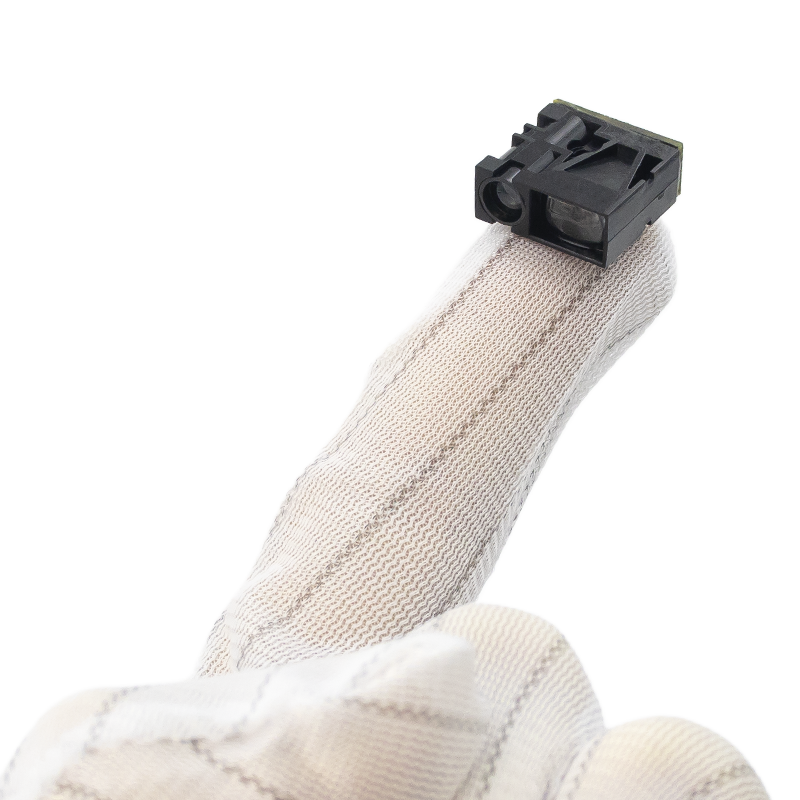
Compact laser distance modules are ideal for:
- AGV robots
- Embedded industrial devices
- Smart robotics
- UAV systems
- Intelligent equipment
- Portable automation tools
Despite their small size, modern laser modules can still achieve:
- ±1mm accuracy
- Fast response speed
- Long measuring distance
- Real-time data output
Many modules also support communication interfaces such as TTL, RS232, RS485, and Bluetooth, enabling easy integration with PLCs, Arduino, Raspberry Pi, ESP32, and industrial controllers.
Phase-Shift Technology Improves Accuracy
Many high precision industrial sensors use phase-shift laser measurement technology because it provides stable and repeatable ranging performance.
The system calculates distance by measuring the phase difference between emitted and reflected laser signals.
d=cΔϕ4πfd=\frac{c\Delta\phi}{4\pi f}d=4πfcΔϕ
Compared with traditional sensing technologies, phase-shift laser systems provide:
- Better short-range precision
- Faster measurement frequency
- Higher stability
- Improved industrial reliability
This technology is especially suitable for applications requiring accurate real-time positioning and automated process control.
Key Applications of Industrial Sensors Automation
Industrial automation systems are expanding into more industries every year. High precision laser sensors now support a wide variety of smart manufacturing applications.
Smart Warehousing
Warehouse automation systems use laser sensors for pallet positioning, inventory tracking, and AGV navigation.
Robotic Automation
Laser distance modules improve robotic arm positioning and automated assembly accuracy.
Intelligent Production Lines
Manufacturers use industrial sensors to optimize conveyor systems, monitor material movement, and improve production efficiency.
Elevator and Building Automation
Laser sensors help achieve accurate elevator positioning and intelligent building control.
Smart Agriculture Equipment
Agricultural automation systems use laser measurement technology for machinery positioning and obstacle detection.
Advantages of Industrial Sensors Automation
Modern factories are increasingly investing in industrial sensors automation because it offers multiple long-term advantages.

Improved Productivity
Automation systems operate faster and more consistently than manual processes.
Reduced Labor Costs
Industrial sensors help reduce dependence on manual inspection and machine operation.
Better Product Quality
High precision sensing improves production consistency and reduces manufacturing errors.
Faster Decision-Making
Real-time sensor data allows intelligent systems to respond quickly and improve workflow efficiency.
Enhanced Safety
Distance sensors help prevent collisions and improve workplace safety in automated environments.
The Future of Industrial Automation Sensors
As AI, robotics, and smart manufacturing technologies continue to evolve, industrial sensors automation will become even more important.
Future industrial sensors are expected to become:
- Smaller
- More accurate
- More intelligent
- Faster
- Easier to integrate
Laser measurement sensors and industrial laser rangefinders will continue to play a critical role in smart factory development.
Manufacturers that adopt advanced laser sensing technologies early can improve operational efficiency, optimize automation systems, and strengthen long-term competitiveness.
Conclusion
Industrial sensors automation is transforming modern manufacturing by enabling smarter, faster, and more accurate factory operations. Technologies such as laser measurement sensors, industrial laser rangefinders, and compact laser distance modules are helping factories improve efficiency, automation accuracy, and production reliability.
As smart manufacturing continues to expand in 2026, high precision industrial sensing technology will remain a key driver of industrial automation innovation.