

TC25 UAV Laser Rangefinder Module for Long-Range Drone Distance Measurement
As UAV technology rapidly advances across industrial automation, aerial surveying, intelligent security, and autonomous navigation, accurate long-range distance measurement has become one of the most critical functions in modern drone systems.
To meet the growing demand for high-performance aerial sensing, the TC25 UAV laser rangefinder module provides a reliable and compact long-range distance measurement solution specifically designed for drone integration.
The TC25 uses a 905nm invisible laser for stable and precise ranging performance while maintaining excellent safety and environmental adaptability. With a maximum measuring distance of up to 1200 meters and measurement accuracy of 1 meter, the TC25 is suitable for long-range UAV applications including surveillance, target positioning, terrain observation, infrastructure inspection, and intelligent navigation.
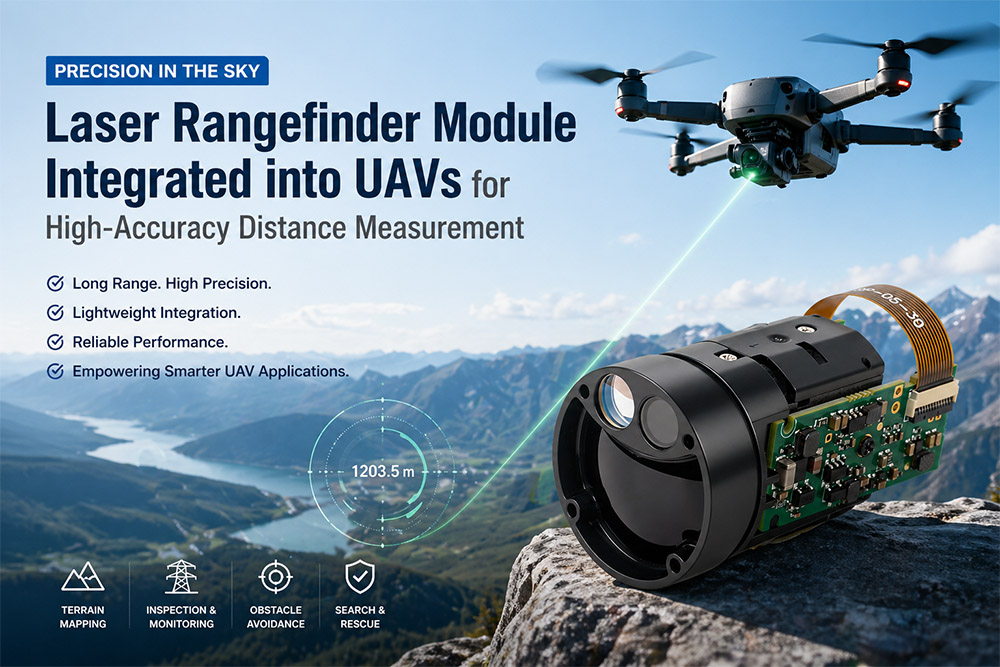
Compared with traditional ultrasonic or infrared distance sensors, the TC25 laser rangefinder for drone systems offers:
- Longer detection distance
- Better outdoor performance
- Faster response speed
- Strong anti-interference capability
- Lightweight integration design
- Reliable long-distance measurement
As industrial drones become smarter and more autonomous, UAV laser rangefinder module technology is becoming a core component in next-generation UAV systems.
Why UAVs Need Accurate Distance Measurement
Distance measurement is critical for UAV operation because drones constantly interact with dynamic environments. Whether flying near buildings, inspecting power lines, mapping terrain, or landing automatically, the UAV must continuously understand its distance from surrounding objects.
Traditional sensing technologies often face limitations:
- Ultrasonic sensors have short detection ranges
- Vision systems are affected by lighting conditions
- Infrared sensors may fail outdoors under strong sunlight
- GPS alone cannot provide precise obstacle distance information
Laser rangefinder modules solve these challenges by using laser beams to calculate the distance between the UAV and target objects with high precision.
This capability allows drones to:
- Maintain stable altitude
- Avoid obstacles in real time
- Perform terrain following
- Conduct accurate object positioning
- Improve autonomous flight safety
- Generate precise mapping data
- Support intelligent landing systems
As UAV automation increases, laser distance measurement technology is becoming a key enabling component.
How a Laser Rangefinder Module Works on a UAV
A UAV laser rangefinder module typically emits a laser beam toward a target surface and measures the reflected signal to calculate distance.
Several ranging technologies are commonly used:
Phase Shift Laser Ranging
Phase-based laser distance modules compare the phase difference between emitted and reflected laser signals. This method provides:
- Millimeter-level precision
- Fast refresh rates
- Stable short- to medium-range measurement
- Compact module design
Phase laser ranging is widely used in UAV altitude control, indoor navigation, and precision hovering.
Time of Flight (ToF) Laser Ranging
The TC25 UAV distance sensor uses pulse Time of Flight laser ranging technology.
This method calculates the distance by measuring the time required for the laser pulse to travel from the module to the target and return after reflection.
The TC25 features:
- 905nm invisible laser
- Up to 1200m measuring distance
- 1m measurement accuracy
- Compact and lightweight structure
- Stable outdoor measurement performance
- Fast response for moving UAV platforms
Advantages of Integrating Laser Rangefinder Modules into UAV Systems
Long-Range Measurement Capability
One of the biggest advantages of the TC25 UAV laser rangefinder module is its long-distance measurement capability.
With a maximum ranging distance of 1200 meters, the module allows drones to perform accurate measurement tasks in large outdoor environments.
This level of accuracy is especially important for:
- Power line inspection
- Bridge monitoring
- Building facade scanning
- Precision agriculture
- Automated drone docking
Lightweight and Compact Design
Weight is extremely important in UAV design. Modern laser rangefinder modules are optimized for compact integration.
Miniature modules can weigh only a few grams while still providing long-distance ranging capability. This allows UAV manufacturers to maintain longer flight time and better payload balance.
Excellent Outdoor Performance
Unlike some traditional sensing technologies, laser rangefinder modules can maintain stable performance in outdoor environments.
Certain green laser solutions even provide improved visibility and target recognition under bright sunlight conditions.
Strong Anti-Interference Capability
Industrial UAV applications often involve complex environments with dust, sunlight, reflective surfaces, or electromagnetic interference.
Laser rangefinder technology offers strong environmental adaptability and reliable ranging performance across different operating conditions.
Key UAV Applications Using Laser Rangefinder Modules
Terrain Following Flight
In mountainous or uneven terrain environments, UAVs need to continuously adjust flight altitude.
Laser rangefinder modules allow drones to measure the ground distance in real time, enabling stable low-altitude flight and improving mission safety.
This function is commonly used in:
- Agricultural spraying drones
- Military reconnaissance UAVs
- Forestry inspection drones
- Search and rescue UAVs
Power Line and Infrastructure Inspection
Utility inspection drones require accurate distance control when flying near transmission towers, bridges, pipelines, or wind turbines.
Laser ranging modules help maintain safe distances while ensuring high-quality inspection imaging.
This improves:
- Inspection efficiency
- Data accuracy
- Operational safety
- Automation capability
Precision Agriculture
Modern agricultural UAVs increasingly rely on laser distance sensors for:
- Crop height monitoring
- Terrain analysis
- Smart spraying height control
- Orchard navigation
- Autonomous route adjustment
By accurately measuring ground distance and crop canopy height, drones can optimize pesticide spraying and fertilizer distributio
Autonomous Landing Assistance
Landing is one of the most critical phases of UAV operation.
Laser distance modules help drones measure the distance to the landing surface with high precision, improving landing stability even in low-light or uneven terrain conditions.
This technology is especially useful for:
- Delivery drones
- Industrial UAV platforms
- Automated charging stations
- Smart warehouse UAV systems
Important Factors When Selecting a UAV Laser Rangefinder Module
Choosing the right laser rangefinder module for UAV integration depends on several technical factors.
Measurement Range
Different UAV applications require different ranging distances.
Examples include:
- 0.1–30m for indoor drones
- 0.2–100m for industrial inspection
- 5–1000m+ for long-range surveillance UAVs
Accuracy Requirements
For long-range drone applications, stable distance accuracy is essential.
The TC25 UAV distance sensor provides 1m measurement accuracy, which is suitable for:
- UAV observation systems
- Long-range target positioning
- Security patrol drones
- Terrain monitoring
- Industrial inspection
- Autonomous navigation support
The module maintains reliable performance in complex outdoor environments.
Interface Compatibility
Most UAV systems require easy integration with flight controllers and onboard computers.
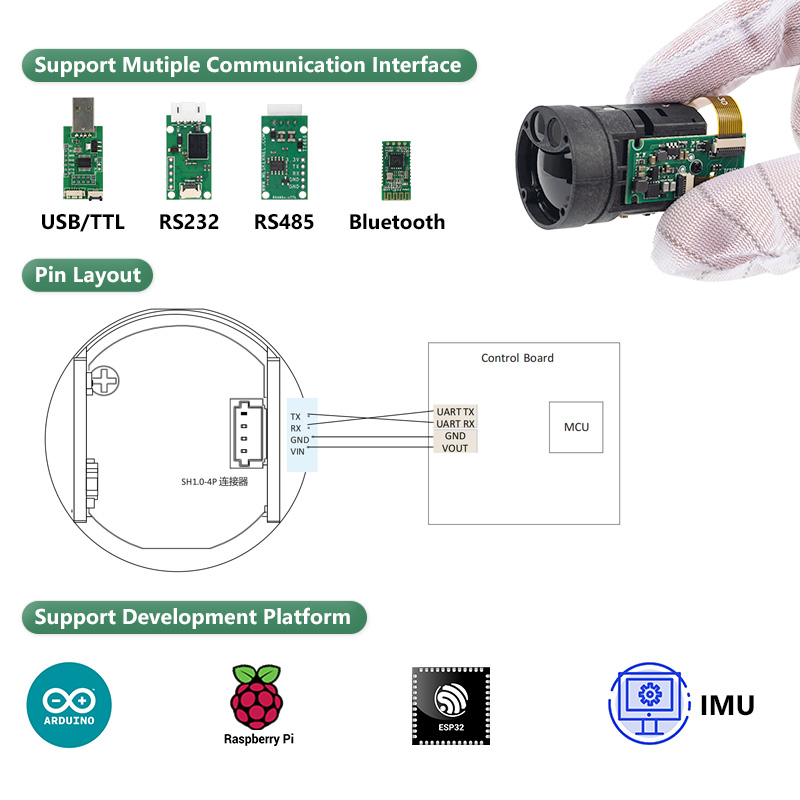
Common interfaces include:
- UART
- TTL
- RS232
- RS485
- USB
- I2C
Compatibility with platforms such as Pixhawk, Raspberry Pi, Arduino, NVIDIA Jetson, and ESP32 is also important.
Power Consumption
Low power consumption directly affects UAV flight duration.
Efficient laser distance modules help extend operational time while maintaining stable ranging performance.
Environmental Adaptability
Outdoor UAV operations may involve:
- Strong sunlight
- Rain
- Dust
- Fog
- Temperature variation
- Vibration
Industrial-grade laser rangefinder modules should provide reliable operation across these conditions.
Emerging Trends in UAV Laser Ranging Technology
The UAV industry is moving toward smarter and more autonomous flight systems.
As a result, laser rangefinder modules are evolving rapidly.
Smaller and Lighter Modules
Manufacturers continue reducing module size and weight while increasing ranging capability.
Future UAV sensors will offer:
- Longer range
- Higher frequency
- Lower power consumption
- Easier embedded integration
AI-Assisted Navigation
Laser ranging data is increasingly combined with AI algorithms and computer vision systems.
This enables drones to perform:
- Intelligent obstacle prediction
- Autonomous route planning
- Dynamic environmental adaptation
- Real-time object recognition
Multi-Sensor Fusion
Modern UAVs often combine:
- Laser rangefinder modules
- LiDAR systems
- Cameras
- IMUs
- GNSS
- Radar sensors
This multi-sensor fusion significantly improves navigation reliability and positioning accuracy.
Expansion into Commercial Automation
Laser ranging UAV technology is rapidly entering:
- Smart cities
- Warehouse automation
- Infrastructure digitalization
- Automated inspection systems
- Security monitoring
- Autonomous logistics
The demand for stable and compact laser distance sensing solutions is expected to continue growing.
Why the TC25 UAV Laser Rangefinder Module Is Ideal for Modern Drone Systems
As drones become more intelligent and autonomous, precise environmental awareness is increasingly important.
Laser rangefinder modules provide the accurate distance data required for:
- Autonomous navigation
- Safe flight control
- Precision mapping
- Intelligent inspection
- Obstacle avoidance
- Smart landing
Compared with traditional sensing methods, laser ranging technology offers a better balance of precision, speed, compactness, and environmental adaptability.
For UAV manufacturers, system integrators, and industrial automation developers, integrating a high-performance laser rangefinder module is becoming a critical step toward advanced drone capability.
Conclusion
As UAV technology continues evolving toward intelligent automation and long-range operation, reliable distance measurement becomes increasingly important.
The TC25 UAV laser rangefinder module combines:
- 905nm invisible laser technology
- Up to 1200m measuring range
- 1m accuracy
- Compact integration design
- Stable outdoor performance
- Fast ranging capability
These features make the TC25 an ideal laser rangefinder for drone systems used in surveillance, inspection, mapping, autonomous navigation, and industrial UAV applications.
For drone manufacturers and UAV system integrators seeking a professional drone distance measurement sensor, the TC25 provides an effective balance of long-range performance, lightweight structure, and reliable operation.
As the demand for intelligent UAV systems continues growing worldwide, advanced UAV distance sensor technology like the TC25 will play an increasingly important role in the future of aerial robotics.
FAQ
What is a UAV laser rangefinder module?
A UAV laser rangefinder module is a compact laser distance measurement device integrated into drones to measure the distance between the UAV and surrounding objects or terrain.
Why are laser rangefinder modules better than ultrasonic sensors for UAVs?
Laser rangefinder modules provide longer measurement range, higher accuracy, faster response speed, and better outdoor performance compared with ultrasonic sensors.
Can laser rangefinder modules work outdoors under sunlight?
Yes. Industrial-grade laser distance modules are designed for outdoor environments and can maintain stable performance even under strong sunlight.
What interfaces are commonly supported by UAV laser distance modules?
Typical interfaces include UART, TTL, RS232, RS485, USB, and I2C.
Are lightweight laser rangefinder modules available for small drones?
Yes. Many compact laser ranging modules weigh only a few grams and are optimized for lightweight UAV integration.