

Introduction
As industrial automation, construction, and smart agriculture continue to evolve, the demand for a reliable outdoor laser distance sensor has increased significantly. However, measuring distance accurately under strong sunlight remains a technical challenge.
One of the most critical factors affecting outdoor performance is the laser wavelength, particularly when comparing red laser (620–690nm) and green laser (510–550nm) technologies.
This article explores how these two laser types perform in outdoor environments and how to choose the right solution for your application.
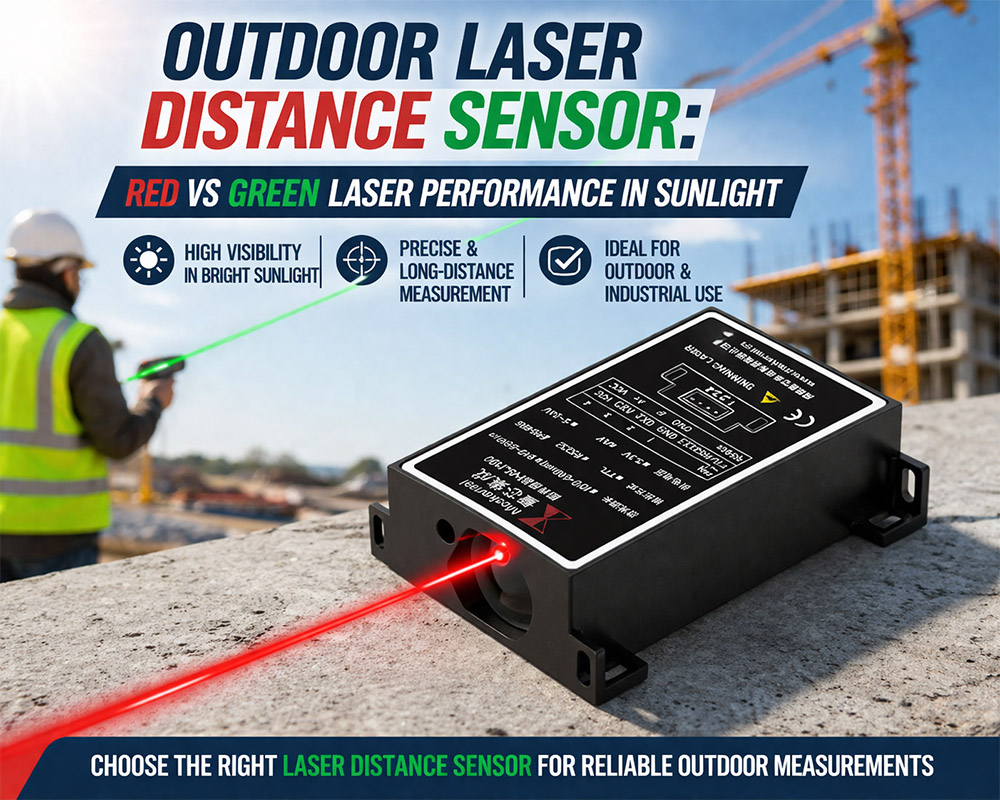
Why Sunlight Affects Laser Distance Sensors
Outdoor environments introduce several challenges:
- Strong ambient light interference
- Low target reflectivity (dark or rough surfaces)
- Long-distance measurement attenuation
- Thermal and environmental fluctuations
Sunlight contains a broad spectrum of light, which can interfere with the sensor receiver, reducing signal strength and accuracy.
Red Laser Distance Sensor in Outdoor Use
Advantages of Red Laser
- Lower cost and widely used
- Mature technology with stable performance
- Suitable for indoor or low-light outdoor environments
Limitations in Sunlight
- Poor visibility under strong sunlight
- Human eyes are less sensitive to red wavelengths
- Reduced performance on long-distance outdoor measurements
In bright outdoor conditions, the red laser spot can become almost invisible, making targeting difficult.
Green Laser Distance Sensor in Outdoor Use
Advantages of Green Laser
- 4–6 times more visible to the human eye than red laser
- Better performance in bright environments
- Easier targeting for long-distance measurement
- Ideal for outdoor and high-ambient-light applications
Considerations
- Slightly higher cost
- Power consumption may be higher
Green lasers significantly improve usability and accuracy in outdoor measurement tasks.
Red vs Green Laser: Key Comparison
| Feature | Red Laser Sensor | Green Laser Sensor |
|---|---|---|
| Wavelength | 620–690nm | 510–550nm |
| Visibility in Sunlight | Low | High |
| Measurement Ease | Moderate | Excellent |
| Cost | Lower | Higher |
| Best Use Case | Indoor / weak light | Outdoor / strong light |
Best Applications for Outdoor Laser Distance Sensors
Outdoor laser distance sensors are widely used in:
- Construction & surveying
- Smart agriculture
- Logistics and warehouse automation
- Traffic monitoring systems
- UAV and robotics navigation
For these scenarios, green laser distance sensors are generally the preferred choice due to their superior visibility and reliability.

Choosing the Right Outdoor Laser Distance Sensor
When selecting a sensor, consider:
- Measurement range (e.g., 0.03–80m or longer)
- Accuracy (±1mm for high precision applications)
- Output interfaces (UART, RS485, Bluetooth, etc.)
- Environmental adaptability (IP rating, temperature range)
Our solutions offer:
- High precision up to ±1mm
- Compact size (as small as 17×7×16.5mm)
- Multi-interface support (Arduino, ESP32, PLC, Raspberry Pi)
- Red & Green laser options for different environments
Conclusion
In outdoor environments, choosing the right laser type is essential for measurement accuracy and efficiency.
- Red laser sensors are cost-effective and suitable for controlled environments
- Green laser sensors excel in bright sunlight and long-distance outdoor applications
For professionals working in challenging lighting conditions, a green outdoor laser distance sensor is the optimal choice.
Looking for a reliable outdoor laser distance sensor?
Contact us today to find the best solution for your application.