

Introduction
Industrial automation is evolving rapidly as manufacturers pursue higher efficiency, greater accuracy, and smarter production systems. Among the many sensing technologies driving this transformation, the laser distance sensor has become a critical component across modern automated factories. By enabling precise, non-contact distance measurement, laser distance sensors help industrial systems monitor positions, control motion, detect objects, and maintain consistent product quality.
With the rise of Industry 4.0, intelligent factories increasingly rely on real-time data and high-precision feedback. Laser distance sensors meet these demands by offering millimeter-level accuracy, fast response times, and stable performance in harsh industrial environments. This article explores how laser distance sensors are applied in industrial automation and why they are becoming indispensable in smart manufacturing systems.

What Is a Laser Distance Sensor?
A laser distance sensor is a measurement device that uses a laser beam to calculate the distance between the sensor and a target object. Common measurement principles include time-of-flight (TOF) and phase-shift technology, both of which are widely used in industrial automation.
Unlike traditional contact sensors, laser distance sensors operate without physical contact, reducing wear and allowing accurate measurement of moving, hot, or fragile objects. Their compact size, digital interfaces, and high repeatability make them ideal for automated production lines.
Key Advantages of Laser Distance Sensors in Industrial Automation
Laser distance sensors offer several advantages that directly support automation requirements:
-
High accuracy and repeatability, often reaching ±1 mm or better
-
Fast measurement speed, suitable for dynamic and high-speed processes
-
Non-contact operation, preventing mechanical wear and contamination
-
Flexible integration, supporting interfaces such as UART, RS232, RS485, Modbus, and Ethernet
-
Long service life, even in dusty, vibrating, or temperature-variable environments
These features make laser distance sensors well suited for continuous operation in industrial settings.
Core Applications in Industrial Automation
1. Positioning and Motion Control
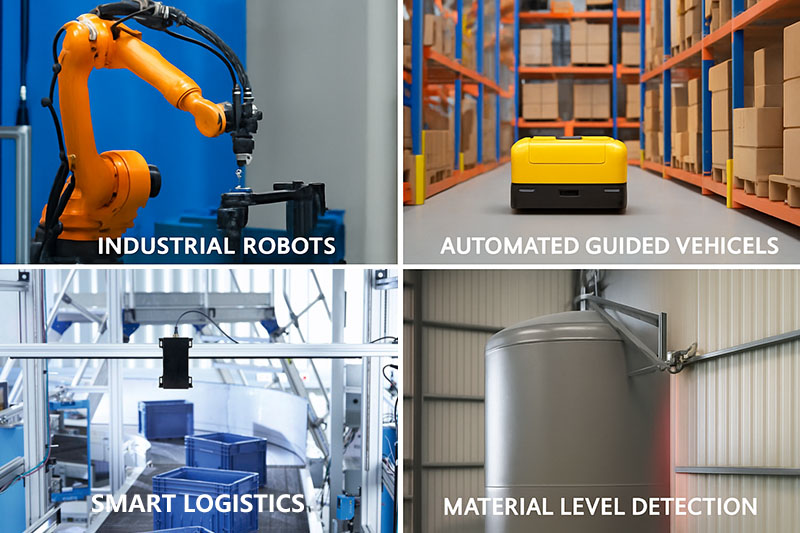
One of the most common applications of laser distance sensors in industrial automation is position measurement. In automated machinery, robotic arms, and linear stages, accurate position feedback is essential for precise motion control.
Laser distance sensors provide real-time distance data that allows control systems to adjust movement with high precision. This is especially important in applications such as CNC machines, automated assembly systems, and robotic pick-and-place operations.
2. Object Detection and Presence Monitoring
In automated production lines, detecting whether an object is present, correctly positioned, or moving as expected is critical. Laser distance sensors are widely used for object detection, height checking, and gap measurement.
Compared to traditional photoelectric sensors, laser distance sensors offer longer detection ranges and more detailed distance information, enabling smarter decision-making within PLC or industrial controller systems.
3. Conveyor and Material Handling Systems
Material handling is a core part of industrial automation, and laser distance sensors play a vital role in conveyor monitoring. They are used to measure object spacing, detect jams, and control conveyor speed.
By continuously measuring distances between products, laser distance sensors help optimize throughput and prevent collisions or misalignment, improving overall production efficiency.
4. Quality Control and Dimensional Measurement
Laser distance sensors are widely used in automated quality inspection systems. They can measure thickness, height, flatness, or deformation of products during manufacturing.
In industries such as electronics, metal processing, and packaging, laser distance sensors help ensure that products meet strict dimensional tolerances without slowing down production. This real-time inspection capability reduces waste and improves yield.
5. Level Measurement and Position Feedback
In industrial automation environments such as warehouses, silos, and automated storage systems, laser distance sensors are used for level measurement and vertical positioning.
They provide accurate distance data for stack height monitoring, platform positioning, and automated lifting systems. Because laser distance sensors can operate over long ranges, they are well suited for both small-scale machinery and large industrial installations.
Integration with Industrial Control Systems
Modern laser distance sensors are designed for easy integration into industrial automation systems. They typically support standard industrial communication protocols, allowing seamless connection to PLCs, industrial PCs, and embedded controllers.
With digital output options and high update rates, laser distance sensors enable real-time feedback loops that are essential for closed-loop control systems. This integration capability supports predictive maintenance, data logging, and smart factory analytics.
Role in Smart Manufacturing and Industry 4.0
As factories move toward smart manufacturing, laser distance sensors are becoming key data sources for automation and digitalization. Their precise measurement data supports advanced applications such as adaptive control, process optimization, and digital twins.
By providing reliable distance information, laser distance sensors help bridge the gap between physical equipment and digital systems, enabling more intelligent and autonomous industrial operations.

Conclusion
Laser distance sensors have become an essential technology in industrial automation. From positioning and motion control to quality inspection and material handling, their accuracy, speed, and reliability support a wide range of automated applications.
As Industry 4.0 continues to advance, the demand for precise, non-contact measurement will only increase. Laser distance sensors, with their flexibility and high performance, will continue to play a critical role in improving productivity, reducing errors, and enabling smarter manufacturing systems worldwide.