

Overview:
As global logistics and port industries continue to expand, the need for improved efficiency and precision in container crane operations has never been more critical. To meet this demand, industrial laser distance sensors are increasingly being adopted in container cranes, offering enhanced accuracy, speed, and safety during cargo handling.
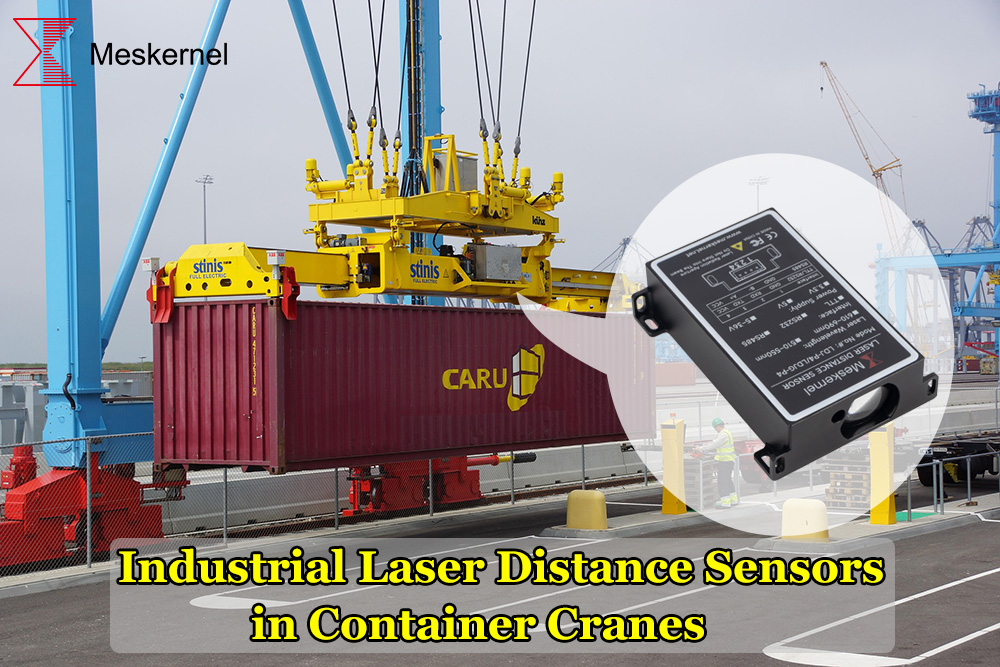
Container cranes, essential for unloading and moving large containers from ships to shore, operate in high-pressure environments where precision is key. The integration of industrial laser distance sensors into these cranes has revolutionized the way operations are conducted, making them faster, safer, and more accurate.
Traditionally, container crane operators relied on basic sensors and manual inputs to gauge distances, often leading to slow operations, occasional misplacement of containers, and even safety risks. Industrial laser distance sensors, however, provide highly accurate, real-time measurements that ensure precise container handling, reducing errors and improving overall efficiency.
How Industrial Laser Distance Sensors Improve Container Crane Operations:
-
High Precision in Container Handling:
Laser distance sensors offer millimeter-level accuracy, enabling container cranes to position and lift containers with extreme precision. This is particularly vital when containers need to be placed in tight spaces or stacked in a highly organized manner. By ensuring exact placement, laser sensors contribute to a smoother workflow and prevent costly mistakes that could arise from misplacement. -
Efficient Vertical and Horizontal Measurement:
Laser sensors enable both vertical and horizontal distance measurements, which is crucial for container cranes in handling tall stacks of containers and ensuring they are safely lifted and lowered. These sensors can quickly determine the exact distance between the crane's lifting mechanism and the container, allowing operators to adjust movements in real-time. -
Reduced Wear and Tear on Equipment:
By providing more accurate measurements, laser sensors help to optimize crane movements, reducing unnecessary over-adjustments or abrupt movements. This leads to less strain on the mechanical parts of the crane, prolonging the lifespan of the equipment and minimizing maintenance costs. -
Enhanced Safety Features:
Safety is a top priority in port operations, where large, heavy containers are regularly moved. Laser distance sensors ensure that containers are handled with precision, reducing the likelihood of accidents, such as containers accidentally colliding with other machinery, structures, or even personnel. The sensors can also detect objects in the crane’s path, activating alarms or halting movements to prevent collisions. -
Real-Time Data Transmission for Dynamic Control:
Modern laser distance sensors are equipped with wireless communication capabilities, allowing for real-time data transmission between the crane’s sensors and its control system. This continuous data feed helps operators make immediate adjustments to crane operations, optimizing container handling and streamlining workflows. Automated systems can even utilize this data to adjust crane speeds or lifting angles based on container weight and position. -
Support for Automated Crane Systems:
With the rise of autonomous and semi-autonomous cranes, laser distance sensors are integral to providing the precise measurement data needed for these systems to operate effectively. In automated ports, where cranes are often controlled remotely or run autonomously, laser sensors are used to guide the crane’s movements with unparalleled accuracy, ensuring containers are placed in the correct positions every time.
Application Examples:
Around the world, many modern ports have adopted laser distance sensors for container cranes. For instance, at the Port of Rotterdam, one of Europe’s largest and busiest ports, laser sensors are integral to the port’s automated container handling system. These sensors allow cranes to measure the distance to containers with precision, enabling seamless transfer from ship to shore. Similarly, at the Port of Shanghai, laser distance sensors play a vital role in the port’s large-scale container yard, optimizing crane operations to handle thousands of containers per day efficiently.
At the Port of Long Beach in the United States, a fleet of automated cranes uses laser distance sensors to streamline operations. These sensors help the cranes calculate the height and distance of stacked containers, adjusting their lifting arms in real-time to ensure containers are lifted and placed correctly. This system has significantly improved both operational speed and safety.
Looking Ahead:
As the demand for automated, high-efficiency ports grows, the role of industrial laser distance sensors will become even more pivotal. By integrating these sensors with other advanced technologies like machine learning and big data analytics, ports can further enhance the accuracy, speed, and safety of crane operations. In the future, laser sensors may also support predictive maintenance, helping operators identify potential issues before they arise, ensuring continuous and reliable operation of crane systems.
Conclusion:
The integration of industrial laser distance sensors into container crane operations marks a significant step toward more efficient, precise, and safe cargo handling. As the global logistics industry evolves, the adoption of such advanced technologies will help ports meet growing demands while maintaining safety standards and operational excellence. With their ability to provide millimeter-level accuracy, laser distance sensors are transforming container cranes into smarter, more capable machines that will play a crucial role in the future of logistics.