

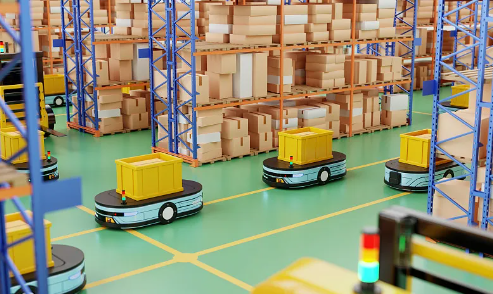
1. Applications of Laser Distance Sensors in Warehousing
Laser distance sensors help warehouses make better use of limited space. Here are some specific applications:
- Rack Height Measurement
Laser sensors provide real-time measurement of rack heights and storage space usage, enabling accurate optimization of warehouse layouts. - Stacking Safety Monitoring
During stacking operations, laser sensors can precisely monitor stack heights to prevent safety risks caused by over-stacking. - Dynamic Inventory Management
By continuously feeding location data to the warehouse management system, laser sensors help ensure real-time inventory updates, reducing errors and overstocking.
2. Applications of Laser Sensors in Logistics
Efficient logistics operations rely on precise distance measurement and object detection. Laser distance sensors excel in the following areas:
- Automated Sorting Systems
Laser sensors quickly detect the location and dimensions of goods, providing accurate data for sorting systems and increasing sorting efficiency. - Transportation Path Optimization
Used on conveyor belts or Automated Guided Vehicles (AGVs), laser sensors detect obstacles in real-time, ensuring smooth transportation processes. - Loading and Unloading Assistance
Laser sensors monitor truck loading spaces, guiding workers or robotic arms to perform loading and unloading tasks more efficiently.
3. Advantages of Laser Distance Sensors
Compared to other distance measurement technologies, laser distance sensors offer several significant advantages:
- High-Precision Measurement
With millimeter-level accuracy, laser sensors meet the strict data requirements of warehousing and logistics. - Fast Response Times
Laser sensors feature high-speed sampling capabilities, providing real-time measurements even in dynamic environments. - Strong Reliability
Whether in bright environments or low-light warehouses, laser sensors maintain stable performance, adapting to various complex conditions.
4. Application Case Study
A leading logistics company implemented laser distance sensors to achieve intelligent warehouse management. Using sensors to monitor inventory in real-time, they improved storage utilization by 20%. Additionally, on their sorting lines, laser sensors enabled precise product categorization, significantly increasing operational efficiency.
5. Future Outlook
As automation technology continues to evolve, laser distance sensors will find even broader applications in warehouse and logistics systems. Their efficiency, precision, and stability will further drive the development of intelligent logistics and storage systems, helping businesses gain a competitive edge.
Conclusion
Laser distance sensors provide innovative optimization solutions for warehouse and logistics systems. From enhancing space utilization to improving automation, they help reduce operational costs and boost productivity. If you’re interested in learning more about how laser distance sensors, laser rangefinder sensor, industrial laser distance sensors can empower your business, feel free to contact us for more information.